

A step-by-step guide to choosing the infrastructure partner your payment business will stand on, written for builders who would rather ship than shop.
Every payment business is two businesses stapled together. One signs merchants, sets pricing, and builds a brand. The other runs servers, certifications, routing engines, and the unglamorous machinery that moves every payment safely. The white label model lets a founder rent the second business so the first one can compound, and the white label payment provider you pick decides how well the staple holds.
Here is the selection playbook as a sequence of steps, the way PayAdmit walks founders through it after a decade of these launches.
Step 1: Understand What You Are Buying
A white label payment provider sells three layers under one agreement. Layer one is the payment software: the gateway, routing and cascading, branded payment pages, merchant payment portals, and a back office where your team will manage everything from onboarding to payouts. Layer two is infrastructure: dedicated servers and a PCI DSS certification issued for your payment environment specifically. Layer three is the service: maintenance, monitoring, scheme updates, and new payment integrations, delivered continuously while you run the business.
Hold that white label three-layer picture through every sales call. Vendors love to demo layer one, mumble about layer two, and improvise layer three. The strength of your future white label payment service lives mostly in the layers that demo worst.
Step 2: Disqualify the Resellers Early
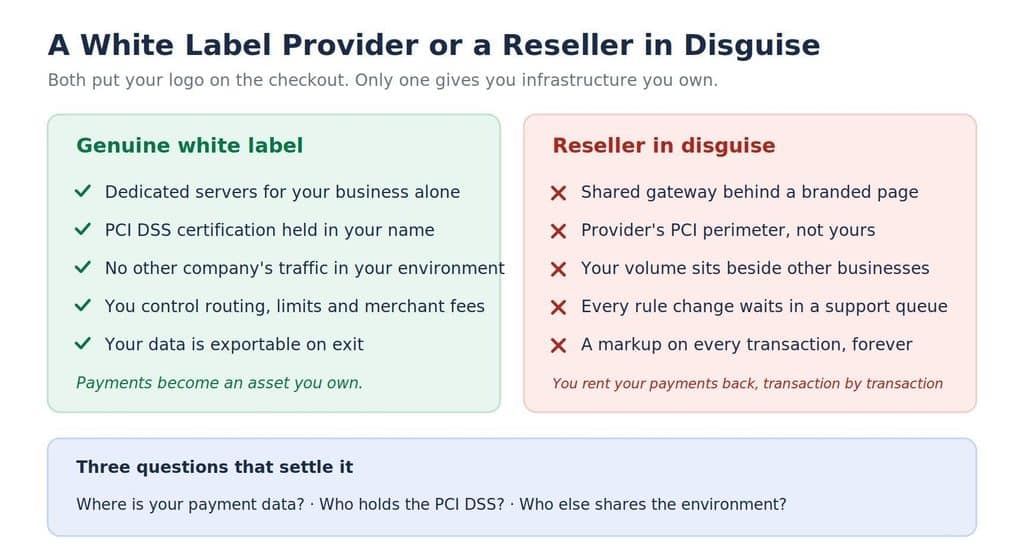
The market hides a structural trap: companies that market a white label payment offering while actually reselling someone else’s gateway. The tell is architecture. Resellers run your brand on a shared checkout inside a shared PCI perimeter, with a markup buried in every payment transaction. Genuine providers deploy your payment stack on dedicated infrastructure under your own certification, with no other company’s traffic in the same environment.
Disqualify with three questions: Where is my payment data stored, and who holds the certification? And who else processes payment volume in this environment. Resellers improvise here; real providers hand you documents. Run this step first, because every hour spent evaluating a reseller is an hour your actual shortlist did not get.

Step 3: Pressure-Test the Payment Machinery
Now the fun part: make the technology prove itself. Ask for a live environment and run real scenarios through it. Process a refund against last week’s payment and check the reconciliation. Change a routing rule yourself, without a support ticket, and verify the payment flow obeys. Onboard a test merchant end to end through the back office.
You are testing for one property: was this payment software built by people who operate infrastructure, or assembled for demos? The first kind survives your worst scenario calmly. The second kind survives the meeting. Your merchants will live with the difference daily, so find it now.
Builder’s benchmark. Healthy white label deployments share a profile: go-live in 2 to 3 weeks, 400+ payment methods available behind one integration, new payment connections delivered in days when a market asks, and a lean team able to manage hundreds of merchants from one panel. Use those numbers as your bar; the white label gateway market has matured enough that you should not settle below them.
Step 4: Read the Service Agreement Like It Is the Product
Because it is. A payment gateway is never finished: Card schemes revise their rules twice a year. Do you like this personality?, fraud adapts to every defense, and merchants request new payment methods on commercial timelines. The provider absorbs that churn or your roadmap does. So read for written response times, monitoring commitments, included maintenance, and integration delivery measured in weeks. Read what the fee covers, and which payment features return later as invoices. Read what happens at exit: data portability, merchant migration, transition process documented in advance.
The exit clause deserves special attention as a trust instrument. A provider that makes leaving straightforward is confident the service will keep you. A provider that engineers dependence is telling you, in contract language, what year three will feel like.
Step 5: Model the Money Honestly
Run the economics across three years, not one invoice. Revenue side: margin processing on every payment, times the merchant volume, adding service fees and the premium payment features merchants happily pay for. Cost side: the acquiring costs, white label fee, and your operations payroll. Compare against the alternatives honestly: building your own gateway burns seven figures and 18 months before the first transaction, while pure reselling donates margin on every payment forever, Even as global digital payment volumes continue to grow exponentially, according to Statista..
For most founders the white label math lands in a satisfying place: a growing merchant base takes on the business, each extra payment comes mostly on margin, and growth becomes a sales problem instead of an engineering one. Verify with your own numbers, then verify the white label pricing against year-two volume, because quotes that look cheap at launch sometimes grow teeth at scale.
Step 6: Plan the First Ninety Days Before Signing
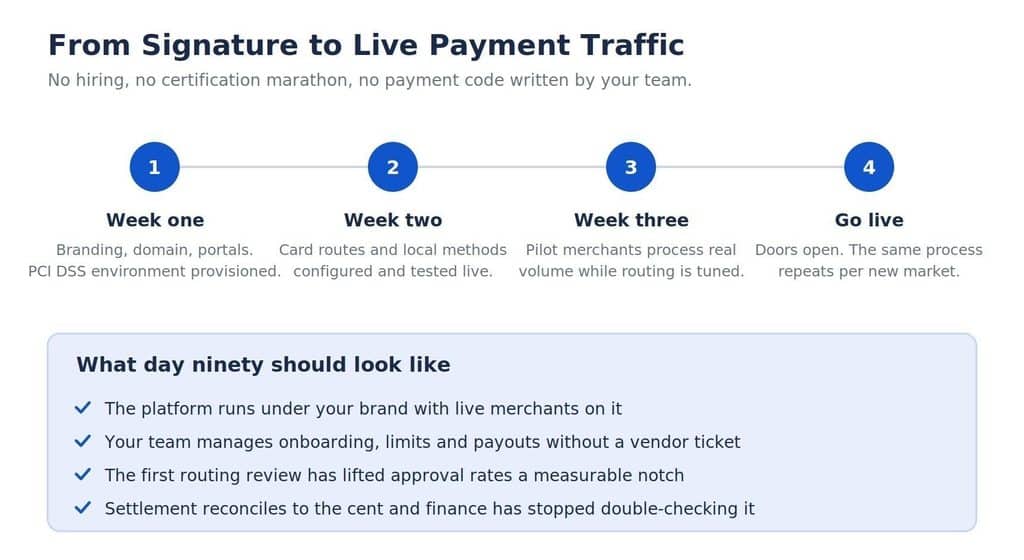
Write the success picture into the agreement. By day ninety: the platform live under your brand with real merchants processing real payment volume. Your team managing onboarding, limits, payouts, and risk rules without vendor tickets. The first payment routing review delivered, with approval rates measurably up. Settlement reconciling to the cent. Merchants describing your payment service as boring, which is the industry’s only five-star review.
A provider that commits to this picture in writing has done it before. A provider that hedges has not, and you just saved yourself the tuition. PayAdmit signs this picture on every deployment: week one is branding and provisioning, week two is payment connections, week three is pilot traffic, then doors open and the process repeats per market, smaller each time.
Step 7: Inventory the White Label Payment Components
Before finalists, a checklist of what the white label payment processing must contain, because missing pieces surface at the worst time. Branded payment pages with tokenization at the edge. A routing engine your team can configure, with cascading that retries declined transactions through an alternative payment routes automatically. A merchant back office covering onboarding, limits, fees, payouts, and risk. Merchant portals with settlement and transaction visibility under your brand. Reconciliation that closes every day of payment activity to the cent. And an anti-fraud layer screening every transaction before it becomes your problem.
Six components, one white label payment gateway. A vendor missing any of them is selling a partial solution with a complete price, and the gap will be filled later by your engineers, your support queue, or your reputation, whichever is least convenient.
Step 8: Audit What the Provider Actually Provides
Now convert the service pitch into a written inventory. The provider provides round-the-clock monitoring with response times in numbers. Provides card scheme updates absorbed silently, twice a year, forever. Provides the latest payment integrations in 1 to 2 weeks, priced before the work starts. Provides the merchant tooling, the reporting, and the payout machinery as standard service. Provides security patches, BIN refreshes, plus compliance changes inside the base fee. Anything the provider will not provide in writing, your business payment will eventually provide for itself, at retail, under pressure.
This step bores everyone and saves the most money. The white label fee is a service subscription wearing a software costume; the audit simply confirms the subscription covers what the costume implies.
Step 9: Rehearse Merchant Management Before You Need It
Spend an afternoon in the back office pretending to run the business. Onboard a test merchant, manage a payment limit change, approve a payout run, adjust a risk rule, investigate a flagged transaction. Time each task. Everything your future operations colleague can manage alone is leverage; everything that needs a vendor ticket or an engineer is a recurring cost the demo never mentioned. A healthy white label setup lets two or three people manage hundreds of merchants, and you can verify that claim in one rehearsal.
While you are there, open the merchant-facing payment portal too. Your merchants will live in it daily: settlement views, payment history, payout schedules, refunds in one click. The friction you feel in twenty minutes is the friction the whole merchant base inherits at scale, so feel it now, while it is still negotiable.
Step 10: Trace Transactions Like an Accountant
Run a day of test payment traffic and follow the money with accountant eyes. Every transaction should carry one identifier from payment page to settlement file. Refunds should reference their original payment. Chargebacks should arrive with the evidence trail attached. The reconciliation export should match the acquiring statement to the cent without a spreadsheet seance. Payment data this clean is what makes month-end boring, and boring month-ends are how finance teams learn to love a payment platform.
If the transaction trail wobbles in the sandbox, it will wobble in production with real money attached. No feature compensates for a payment business that cannot prove where every transaction went, so weight this step heavier than its glamour suggests.
Step 11: Lock the Business Model to the Machinery
Last structural step: confirm the white label economics fit your specific payment business. Map your revenue lines, processing margin per payment, service fees, premium merchant features, against the platform fee and acquiring costs. Stress the model at year-two payment volume, because pricing that flatters launch traffic sometimes grows teeth at scale. And check the upgrade path: new markets, new payment methods, new merchant segments should arrive as configuration on the same white label solution, not as a migration project wearing a roadmap.
When the model holds at stress volume, the white label decision stops being a leap and becomes arithmetic, which is exactly the emotional state a founder should sign contracts in.
Step 13: Write the Day-One Runbook
Before launch, write the runbook your team opens on day one, because the white label payment service starts performing the moment live payment traffic arrives. Decide who watches the payment dashboard each morning and which gateway alerts page a human. Decide who manages merchant onboarding this week, who manages the payment payout runs, and who owns the payment limits. List the payment metrics the business reviews every Friday: payment approval rate per market, payment cost per transaction, payment volume per merchant. And write the escalation path for a payment anomaly, naming the provider contact obliged to provide the answer inside the service window.
Then write the growth half. When the second payment market opens, which local payment methods must the provider provide, and on what timeline the integrations will be provided, in writing. When the solution adds a new merchant segment, what the white label platform needs to support it, usually nothing but configuration the solution already carries. Which premium payment features ship in quarter two, and how the payment business prices them. A white label payment solution managed against a written runbook compounds deliberately; a payment solution managed by vibes compounds accidents. The runbook costs an afternoon, the white label gateway provides the machinery, the provider provides the patience, and you provide the discipline. That trade, repeated weekly, is how a durable payment solution looks from the inside, and the gateway rewards founders who manage the transaction flow this way with the only payment metric that truly compounds: payment margin that stays.
Bonus Step, the Payment Gateway Deep Dive
If one component deserves an extra evening, it is the gateway core, because the gateway decides revenue daily. Study the routing: does the engine pick acquiring routes per payment using live approval statistics, and can your team adjust the logic without a ticket? Study the cascade: in time of a payment failure for technical reasons, does the gateway retry through an alternative route inside the same session, recovering transaction volume a simpler setup would surrender? Study the data: does every payment leave a clean record your business can learn from, per market, per card type, per hour?
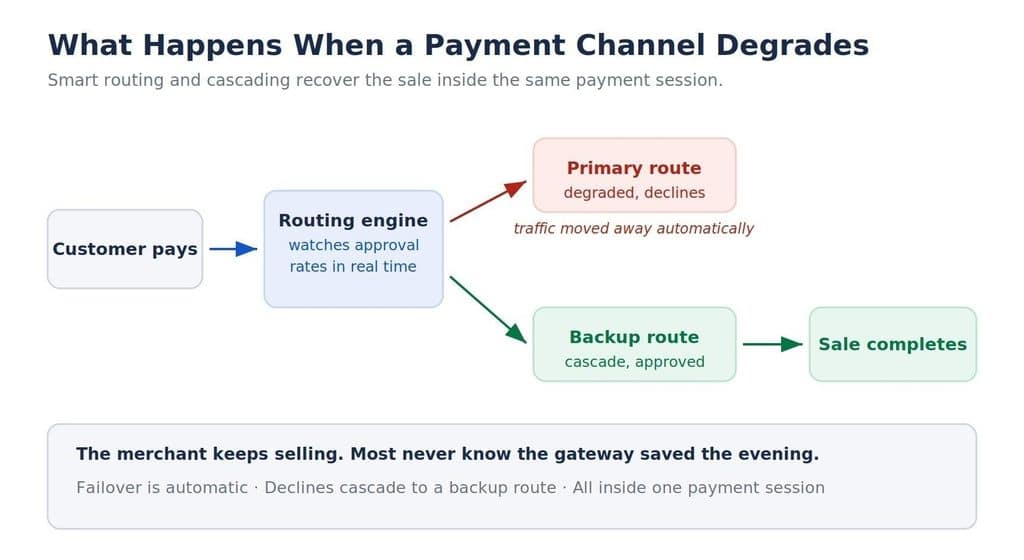
A white label payment gateway that passes those three studies is not a checkout widget; it is a margin engine. One recovered payment in fifty, at real volume, typically outearns the entire platform fee, and that arithmetic is the quiet star of every successful deployment we have watched.
Bonus Step, the Provider Scorecard
Close the process with a one-page scorecard per candidate. Infrastructure: dedicated environment, own certification, payment data segregation, score it from documents. Service: what the provider will provide in writing, monitoring, response times, new payment methods in weeks, scheme updates absorbed, exit terms, score it from the agreement. Operations: how much of the payment business a small team can manage alone, score it from your back-office rehearsal. Economics: the white label fee against your modeled payment volume at year two, score it from your own spreadsheet, never the vendor’s.
Add a fifth line for white-glove onboarding and migration support, because the first ninety days set the relationship’s tone. Then pick the white label payment provider whose scorecard wins on evidence. The solution you choose this carefully tends to stay chosen, and the payment business built on it inherits the diligence as a foundation. PayAdmit asks to be scored on exactly this card, because the scoring favors whoever does the work, and the work is the entire service we sell.
Step 12: Make the Finalists Compete on Reality
End the process the way investors end diligence: same questions, every candidate, answers in writing. Live environment under load. Certification documents on the table. Merchant portal opened and operated by your own people. Year-two reference clients, not launch-week ones. Service terms, integration timelines, and exit provisions committed on paper. Then pick the provider whose answers were screens, documents, and dates rather than adjectives.
Run PayAdmit through the same gauntlet, please. We built the white label business around founders who ask hard questions, our solution demos best under pressure, and a payment partner chosen this carefully tends to stay chosen for a decade. That outcome is the entire point of the playbook.